先日カブトムシを取りに山に行ってきました.台風直撃が心配されてましたが,どうにか避けて雨もなく,熱すぎない気温にがぜん期待は高まっていました!
車で23:30に出発,夜中に山へ向かう道は車通りも非常に少なく,道路は安心して走れます.とりあえず山の中の郵便局に車を止めて,周辺の街灯を見ると...あれ?何もいない...少し歩いて歩道橋まで行くも,カミキリムシがいるぐらい.あれ?こんなもん?雨が無くても,風もいくらも吹いてなくても低気圧の影響は出てる??それか明晩の方がよかった?なんて考えつつ,希望を捨てずに公園に行ってみる.
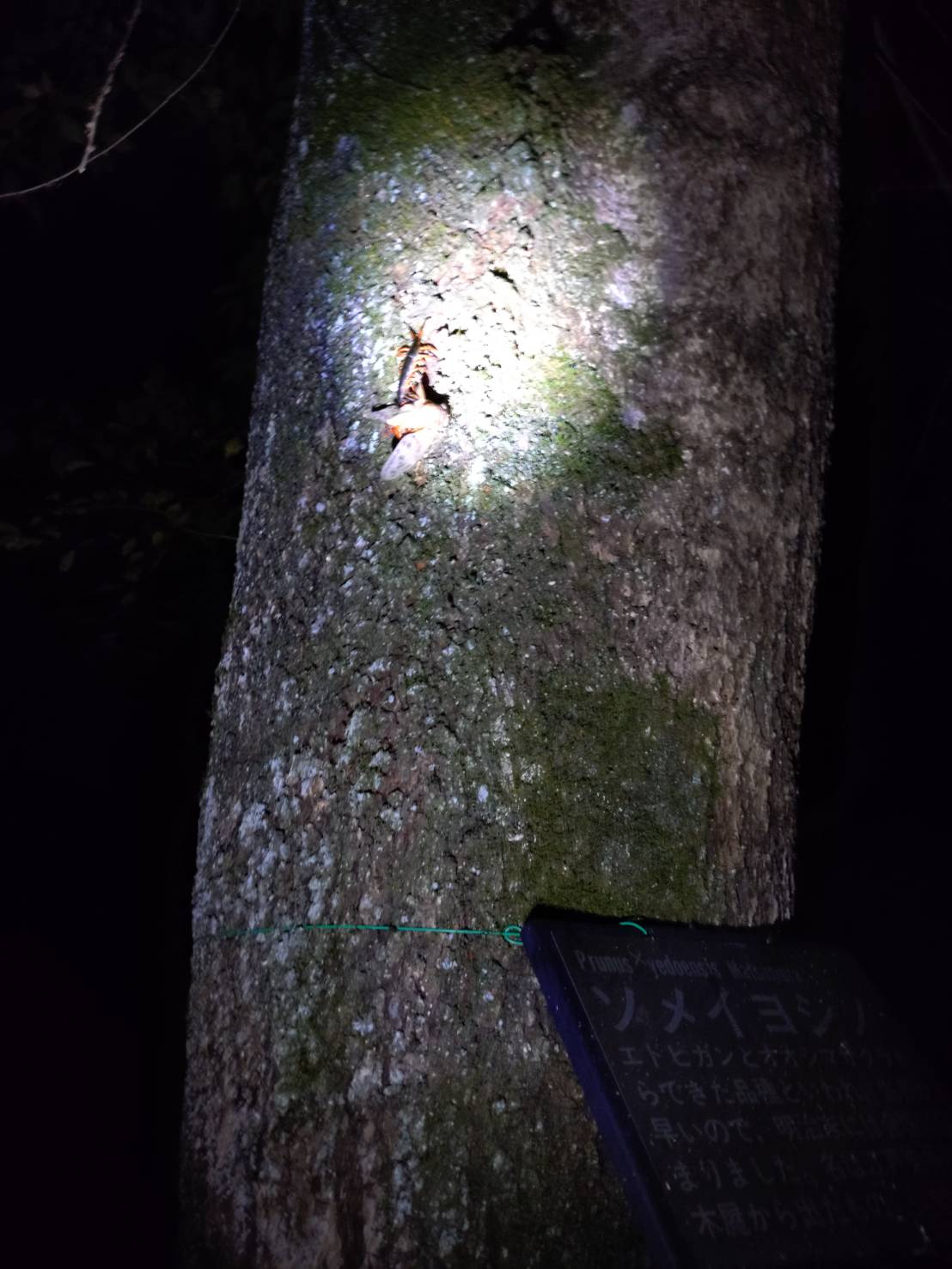
植わってるのは大体桜の木で,樹液は出てる物の何もいない.やっと見つけたのはムカデでセミを捕食してるシーン(アイキャッチ).珍しいシーンに驚きつつも,少し嬉しい.感嘆の声を上げつつ,更に公園を進むも何もいない.桜の中にブナの木を見つけ,見てみるもカナブンが3匹いるだけ.さらに進むと再び桜ではない木を見つけたが...なんと樹液が枯れている.さらに進むと...地面にオサムシがいるが,やはりカブトムシの姿は全く無い...
ちょっとシーズン遅れだったのかしらなんて思いつつ,2時間ほどの冒険を終えました.
ちなみに一緒に行った子は,そもそもその子が行きたい!と言った事もあって行くことになったんですが,すべての虫にビビり,有りにすらビビる始末.結局ほぼ見ずに車へ.私は私で夜の山の一人歩きとか,不審者やら白装束の幽霊やら出そうで超怖い...最後に怪しい別荘?を見つけたところで引き返しました.
ところで,カブトムシシーズンを検索すると,採集にベストなのは7月下旬とか8月上旬って書いてますね.やっぱり台風の影響か,はたまた温暖化の影響か.昔よりずいぶん暑くなったそうですからね.
カブトムシのペット化が盛んになったのは1960年代なのだそうですよ.高度経済成長期で,生活の中にワンポイントを付け足すようになり増えていったとか.逆にそれまでは,スズムシ,コオロギ,マツムシ,クツワムシ...みたいな鳴く虫がメジャーだったそう.江戸時代どころか平安時代の源氏物語にも読まれるぐらい昔からメジャーで,海外でもアリとキリギリスみたいに虫と言えば鳴くやつだよねって印象があるみたいですね.
虫の歴史すごいです.
ではではこの辺で.
EN
The other day, I went up into the mountains to catch some beetles. A typhoon had been a concern, but we somehow avoided it—no rain, and the temperature wasn’t too hot—so my hopes were high!
We left by car at 11:30 p.m. The roads heading into the mountains in the middle of the night were almost empty, which made for a safe and smooth drive. We first parked near a small mountain post office and checked the nearby streetlights… but wait—nothing. Not a single bug. We walked over to a footbridge and finally found a longhorn beetle, but that was it. Huh? Is that normal? Even without rain or strong wind, could the low pressure still be affecting things? Or maybe tomorrow night would have been better? Still clinging to hope, we headed to a nearby park.
Most of the trees there were cherry trees, and while some were oozing sap, there were no insects around. What we did see was a centipede devouring a cicada (pretty eye-catching). It was kind of gross but also fascinating, and I was oddly happy to see it. We kept exploring deeper into the park but again—nothing. One beech tree had three beetles on it, but that was about it. We found another non-cherry tree further in, but its sap had dried up. A bit later, we saw a ground beetle crawling on the path—but still no sign of any rhinoceros beetles at all.
I started to wonder if we were just a bit too late in the season. After about two hours, our little adventure came to an end.
By the way, the friend who came with me—who was the one who said, “Let’s go!” in the first place—was scared of literally every bug, even ants. In the end, she barely looked around and spent most of the time in the car.
As for me, I was kind of terrified too—walking alone in the mountains at night, worrying about creepy strangers or ghostly figures in white robes. At the very end, we stumbled upon a sketchy-looking villa and decided to turn back.
When you look up beetle season, most sources say that the best time is late July to early August. So maybe the typhoon threw things off, or maybe it’s the effects of global warming. They say it’s gotten much hotter than before.
Apparently, beetles didn’t really become popular pets in Japan until the 1960s. During the postwar economic boom, people started adding little points of joy to their everyday lives.
Before that, it was mostly singing insects like bell crickets, field crickets, pine crickets, and bush crickets that were popular. They were already beloved back in the Edo period—and even show up in The Tale of Genji, which means they’ve been appreciated since at least the Heian era. Even abroad, when people think of insects, they tend to think of the chirping kind—like “The Ant and the Grasshopper.”
Insects really do have a fascinating history.
Well then, I’ll leave it here for now.
FR
L’autre jour, je suis allé à la montagne pour attraper des scarabées. On s’inquiétait d’un typhon, mais on a réussi à l’éviter : il n’a pas plu, la température était supportable, et j’étais super enthousiaste !
On est partis en voiture à 23h30. La route vers la montagne, au milieu de la nuit, était presque vide, ce qui était rassurant. On a d’abord garé la voiture près d’un petit bureau de poste en montagne, puis on est allés voir les lampadaires alentour… mais, euh, rien du tout. Pas un insecte. En marchant un peu jusqu’à une passerelle piétonne, on a trouvé un capricorne, mais c’est tout. Hein ? C’est normal ? Même sans pluie ni vent fort, la basse pression pourrait-elle quand même avoir un effet ? Ou peut-être que demain soir aurait été mieux ? En tout cas, on a gardé espoir et on est allés au parc.
Les arbres étaient presque tous des cerisiers, certains laissaient couler de la sève, mais il n’y avait aucun insecte. La seule scène marquante qu’on a vue, c’était un mille-pattes en train de manger une cigale (vraiment impressionnant). C’était un peu dégoûtant, mais aussi fascinant, et ça m’a un peu fait plaisir.
En continuant dans le parc, toujours rien. On a repéré un hêtre au milieu des cerisiers, et il y avait trois cétoines, mais pas plus. Plus loin, un autre arbre non-cerisier… mais sa sève était déjà sèche. Un peu plus loin encore, un carabe au sol… mais toujours pas la moindre trace de scarabée rhinocéros.
Je me suis demandé si on n’était pas venus un peu tard dans la saison. Après environ deux heures, on a terminé notre petite expédition.
Au fait, la personne qui m’accompagnait—c’est elle qui avait proposé d’y aller—avait peur de tous les insectes. Même des fourmis. Elle est finalement restée presque tout le temps dans la voiture.
Et moi, franchement, j’avais aussi peur : marcher seul dans la montagne la nuit, avec la peur de tomber sur un fou ou un fantôme en robe blanche… À la fin, on a vu une sorte de villa bizarre, et on a décidé de faire demi-tour.
Quand on cherche la “saison des kabutomushi”, il paraît que le meilleur moment pour les attraper, c’est entre fin juillet et début août. Donc c’est peut-être le typhon, ou bien le réchauffement climatique. Il paraît qu’il fait bien plus chaud que dans le passé.
On dit que les scarabées n’ont commencé à devenir populaires comme animaux de compagnie qu’à partir des années 60, pendant la période de forte croissance économique au Japon, quand les gens ont commencé à chercher de petites touches de plaisir dans leur quotidien.
Avant ça, les insectes les plus populaires, c’étaient plutôt ceux qui chantent : grillons, courtilières, locustes… Ils étaient déjà appréciés à l’époque d’Edo, et même cités dans Le Dit du Genji, donc depuis l’époque Heian au moins.
Même à l’étranger, quand on pense aux insectes, ce sont souvent ceux qui chantent qui viennent à l’esprit, comme dans “La cigale et la fourmi”.
L’histoire des insectes est vraiment passionnante.
Bon, je m’arrête là pour aujourd’hui.
