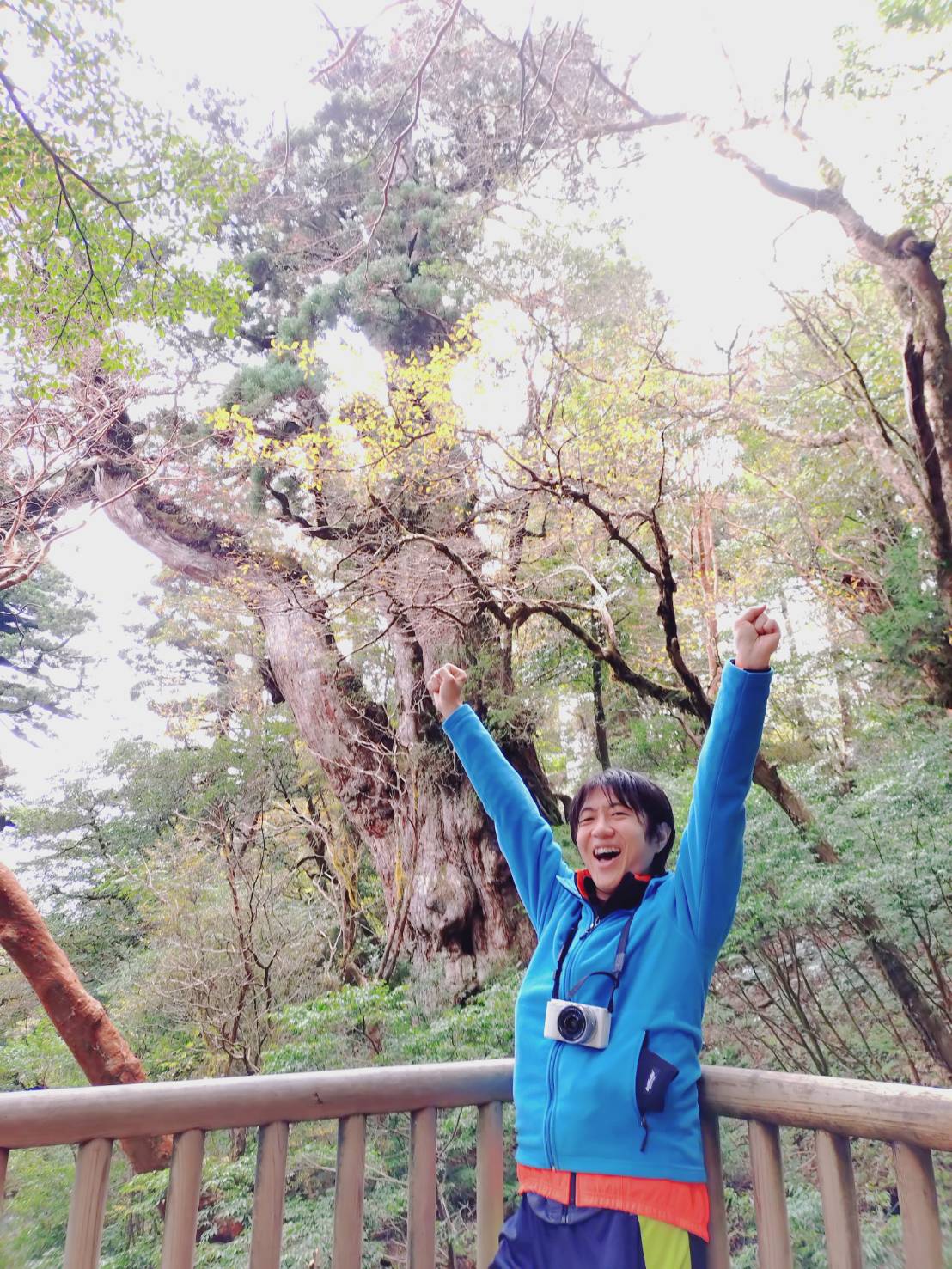
屋久島で縄文杉トレッキングツアーに参加しました.
ゲストハウスから(これについては別途書きます)徒歩5分程の屋久杉細工の店の駐車場に,AM4:20集合です.眠たい目をこすりながら,3:00置きで,軽い朝食を済ませ,歯を磨き,荷物を整理し,出発し,集合場所へ4:10に到着.
そこに来たバスと言うかバンに,名前確認の後乗り込みます.バンに揺られる事15分ほどで,バスへの乗り換え場所に到着.既に多くの人が乗った大型バスに乗り込み,出発する頃には補助席も使う状態です.バスが出発し,40分程で登山口に到着です.
そこで,ガイドの方とチームメイトと合流.6:00から登山開始です.歩き始め前に,荒川登山口の前で写真を撮っていただき,歩き始めました.
バスを降りた場所はトイレなどで明かりがありますが,一度歩き始めると全く明かりが無く,レンタルしたヘッドライトが頼みです.登山とは言いつつ,最初の8.5kmはトロッコのレール上を歩きますが,真っ暗道は嫌が応にも慎重になるし,それでも突っかかります.枕木の上を歩きながら,川を渡り,森を見て,屋久島名物の花こう岩を見る間に明るくなりました.
高所恐怖症なせいで,真っ暗で手すりのないレールが皮を超える時は心底ビビってましたが,明るくなるといいとこ6,7メートルでビビるほどでも無かったなって感じです.また屋久島名物の花こう岩とは,言い様で,屋久島がそもそも花こう岩の上に土が乗っただけの島なんです.土壌はとても薄く,ほとんどが花こう岩なんです.
更にレールの上を歩くと,直に最初の屋久杉が見えてきました.屋久杉を名乗れるのは樹齢1000年以上の杉だけなのだそうです.その昔植林された,樹齢200年ほどのものでも十分大きいですが,1000年物はレベルが違う.孫悟空と仏ぐらい違います.マジでデカい.太い.しかし,そんなデカい物が岩に根を回して頑張って踏ん張って生えてるんです.ガイドの話を聞きながら,そら自然遺産になるわな,なんて思ってました.本当に岩の上に根をたくさん回して頑張って生えてる様は,何とも健気に見えます.
何本もの屋久杉を見つつ,途中で仁王杉を見ました.浅草などで有名な阿吽の阿の方です.吽の方は何年か前に倒れてしまったのですが,仁王の枝は確かに腕を捻りこちらを睨んでるような姿です.もちろん,写真を撮ってもらいました.この辺で5kmほど更に3kmほどもたくさんの屋久杉に驚嘆していると,登山ルート中唯一の水洗トイレがありました.
トイレに寄り...つつ出なかったんですが,実は最初にめちゃくちゃ心配してたおトイレ問題はどうにか大丈夫そうです.
そして,そこからはトロッコ道が終わり,2.5kmの登山らしい登山の開始です.石と土の階段を上り,木の階段を上り,最初に現れた見どころはウィルソン株.いわゆる,ハート杉ってやつです.
株に空いた穴から上を見ると,空に向かってハート形の穴が開いてます.順番を待ちハート形に見えるポイントから上を見ると,なるほどハート.もちろん写真撮影です.帰りには明るい中でハート穴に向かって,手ハートを掲げる自分を取ってもらいました.
次に現れたのは大王杉.実は縄文杉が見つかるまではそれが一番古い過ぎたと言われてました.大王の名に恥じぬデカい杉で,その周囲にある細い杉が従者を従えるように見える事から大王杉だとか.ここでも写真を撮ってもらいました.スポットが多すぎて終始興奮とテンションが冷めません.おーー!!すげーー!!です.
そして,最後に現れたのが,縄文杉.80年ほど前に,この森には巨大な杉があるという言い伝えを信じ,開拓されてない鬱蒼とした山を7年も歩き,見つけてくださった,岩川貞次さんに依り日の目を浴びる事になった杉です.形は縄文時代の火焔型土器に似ているから名付けられて縄文杉は実は縄文時代より前の杉.初知りの知識と,その見た目に,巨大さに,驚嘆しつくしです.驚きながら,歓喜しながら,写真を撮りまくりました.まだまだ見飽きませんでしたが,30分ほどで帰る時間です.後ろ髪を引かれつつ,さよならを言いながら縄文杉を後にしました.
帰り道は同じ道ですが,今度は屋久島の獣たちに驚かされました.人が近づいてもほとんど警戒しない屋久猿は人も自然に一部としか思ってないようです.お互いに干渉しあわないからこそ,2mほどに近づいてもけん制しない関係が保たれているのは感動です.
屋久鹿はお猿よりは警戒してますが,やはり慌てて逃げるようなことは無く,古来から干渉しあわなかった屋久島の人々の生き方が感じられます.
そして,どちらも本州で見るものよりも小さく可愛いです.生物学的には同じ種類なのだそうですが,大人が本州の子どもほどの大きさで毛も長く,愛らしいです.
獣たちに癒されながら,疲れながら,見えてきたのは川です.この川,花こう岩がゴロゴロと転がっていて,なんともののけ姫でアシタカとモロの手当てをするサンがあった場所のモデル.本当に石の陰からアシタカが名乗り出しそうです.そこでも写真を撮り,疲労した足と頭でおしゃべりをしつつ,ついにゴールです.
感動一杯の屋久島,いつかまた行きたい島です.また,触れてませんが,コダマが出そうなコケもたくさんあり,土が少ない代わりにコケによって,石と根っこの摩擦が保たれているのだそう.
かき切れないぐらい見どころがたくさんの島,屋久島.万人に行ってほしい島です.
屋久杉を代表する最大級の巨木「縄文杉」孤高の巨樹は神々しく、王者の風格漂う
【充実の登山装備レンタル付き】屋久島 縄文杉日帰りトレッキングツアー 登山口までの送迎手配も可能 by Yamakara屋久島 | 屋久島の観光・オプショナルツアー専門 VELTRA(ベルトラ)
I joined a guided trekking tour to Jōmon Sugi on Yakushima.
The meeting point was at 4:20 a.m. in the car park of a Yakusugi craft shop, about a five-minute walk from my guesthouse (I’ll write about that separately). Rubbing the sleep from my eyes, I woke up at 3:00, had a light breakfast, brushed my teeth, packed my belongings, and set off, arriving at the meeting place at 4:10.
A van arrived, my name was checked, and I climbed aboard. After about fifteen minutes of being rocked along the road, we reached the transfer point where we changed to a large bus. It was already crowded, and by the time we departed, even the auxiliary seats were in use. After some forty minutes, we arrived at the mountain trailhead.
There, we met our guide and the rest of the group. The trek began at 6:00 a.m. Before setting off, we had our photos taken in front of the Arakawa trail entrance.
The place where we had got off the bus was lit by facilities such as toilets, but once we started walking, there was no light at all. The head torch I had rented became my only reliance. Although it is called “mountain climbing”, the first 8.5 kilometres are actually along old trolley tracks. In pitch darkness, I became careful in spite of myself – and still stumbled. Walking over sleepers, crossing rivers, watching the forest, and noticing Yakushima’s famous granite, the sky slowly grew brighter.
Because I am afraid of heights, crossing rail sections without handrails in complete darkness genuinely terrified me. Once it was light, however, I realised the height was only around six or seven metres – hardly enough to justify the fear. As for the famous granite of Yakushima, in truth the island itself is essentially granite with only a thin layer of soil on top. The soil is extremely shallow, and almost everything beneath is solid rock.
Continuing along the tracks, the first of the Yakusugi came into view. Only cedars over 1,000 years old can be called Yakusugi. Even the planted trees of about 200 years are large enough to be impressive, but the thousand-year-old ones are on another level entirely. The difference is like that between Son Goku and the Buddha. Truly enormous. Thick. And yet, these massive trees cling desperately to the rocks, their roots wrapping tightly around them. Listening to the guide’s explanations, I found myself thinking, “Of course this is a World Natural Heritage site.” The sight of them fighting to live on bare rock, their roots spread everywhere, felt strangely touching.
After seeing many Yakusugi, we came across Niō Sugi. It represents the “A” (阿) of the A-Un pair of guardian figures, like those found at temples. The “Un” tree had fallen some years ago. The branches looked exactly like twisted arms, glaring at us as if guarding something. Naturally, I had my photo taken.
After around five kilometres, then a further three kilometres of awe at endless giant cedars, we reached the only flush toilet on the route. I stopped there… though in the end, the toilet problem I had been so worried about beforehand turned out to be fine.
From there, the trolley tracks ended, and the real mountain trail began for the final 2.5 kilometres. Stone and earthen steps, then wooden steps. The first highlight was Wilson’s Stump, the famous “heart cedar”. Looking up through the hollow, you can see a heart-shaped opening in the sky. After waiting my turn and finding the right position, I saw it clearly: a perfect heart. Of course, I took photos. On the way back, I also had a photo taken of myself making a heart shape with my hands, aimed towards the hollow.
Next came Daio Sugi. Before Jōmon Sugi was discovered, this was thought to be the oldest tree. True to its name, “Great King”, it was immense, and the thinner cedars around it looked like retainers gathered around their lord. Another photo. There were simply too many highlights, and my excitement never faded: “Wow!! Amazing!!”
And finally, the Jōmon Sugi itself appeared. This tree was brought to the world’s attention by Sadatsugu Iwakawa, who believed the legend of a giant cedar hidden in this forest, and walked for seven years through an untouched, dense mountain wilderness to find it. Its shape resembles the flame-pattern pottery of the Jōmon period, which is why it was named Jōmon Sugi – though in truth it is even older than the Jōmon era. I was overwhelmed by both this knowledge and its appearance, its sheer size. Filled with awe and joy, I took countless photos. I could have stared at it forever, but after about thirty minutes, it was time to leave. With reluctance, I said goodbye and turned back.
On the return journey, I was surprised by the wildlife of Yakushima. The Yakushima macaques barely fear humans. It felt as if they saw us as simply another part of nature. The fact that they don’t even threaten or flee when you approach within two metres is deeply moving – a relationship built on mutual non-interference.
The Yakushima deer are a little more cautious than the monkeys, but they too do not panic and run away. You can feel the way of life of the people of Yakushima, who have lived for generations without interfering with these animals.
Both the monkeys and the deer are smaller and cuter than those on Honshu. Biologically they are said to be the same species, yet the adults are about the size of children from the mainland, with longer fur, which makes them especially charming.
While being soothed by the animals, tired but happy, I came upon a river. This river, filled with rounded granite stones, is said to be the model for the place in Princess Mononoke where San cares for Ashitaka. Truly, it felt like Ashitaka might step out from behind a rock at any moment. I took photos there as well, chatting away with a tired body and mind, until at last reaching the goal.
Yakushima is an island full of emotion – a place I want to return to someday. I didn’t even mention the moss that looks as though Kodama might appear from it. With so little soil, it is the moss that maintains the friction between rock and roots.
An island with too many sights to write them all down: Yakushima. An island I wish everyone could visit at least once.
J’ai participé à une randonnée guidée jusqu’au Jōmon Sugi à Yakushima.
Le rendez-vous était à 4 h 20 du matin, sur le parking d’un magasin d’artisanat en cèdre de Yakusugi, à seulement cinq minutes à pied de la guesthouse (j’écrirai à ce sujet plus tard). En me frottant les yeux de sommeil, je me suis levé à 3 h, j’ai pris un petit-déjeuner léger, je me suis brossé les dents, j’ai préparé mes affaires, puis je suis parti. J’arrive au point de rendez-vous à 4 h 10.
Un van arrive, on vérifie mon nom, puis je monte à bord. Après environ 15 minutes de route, nous arrivons au point de transfert vers un grand bus. Le bus est déjà rempli, et au moment du départ, même les sièges d’appoint sont utilisés. Après environ 40 minutes de trajet, nous arrivons au point de départ de la randonnée.
Là, je retrouve le guide et les autres membres du groupe. À 6 h, l’ascension commence. Avant de partir, on nous prend en photo devant l’entrée du sentier d’Arakawa.
Là où le bus nous a déposés, il y avait de la lumière grâce aux toilettes et aux installations, mais dès que nous avons commencé à marcher, il n’y avait plus aucune lumière. La lampe frontale que j’avais louée était mon seul guide. Même si on appelle cela de « l’alpinisme », les premiers 8,5 km se font en marchant sur d’anciens rails de wagonnets. Dans l’obscurité totale, je devenais extrêmement prudent… et je trébuchais quand même. Je marchais sur les traverses, traversais des rivières, regardais la forêt, observais le granit caractéristique de Yakushima… et peu à peu, le jour s’est levé.
Comme je souffre du vertige, passer sur des rails sans rampe, dans le noir, au-dessus du vide, m’a vraiment terrifié. Mais une fois qu’il a fait clair, j’ai réalisé que la hauteur n’était que de 6 ou 7 mètres, pas de quoi paniquer autant. Quant au fameux granit de Yakushima, en réalité, toute l’île repose sur du granit recouvert d’une fine couche de terre. Le sol est extrêmement mince, et presque tout est de la roche.
En continuant à marcher sur les rails, les premiers Yakusugi sont apparus. On ne peut appeler « Yakusugi » que les cèdres âgés de plus de 1000 ans. Même les cèdres plantés il y a 200 ans sont impressionnants, mais ceux de 1000 ans, c’est un autre niveau. La différence est comme entre Son Goku et le Bouddha. Vraiment gigantesques. Épais. Et pourtant, ces arbres énormes s’accrochent à la roche, en enroulant leurs racines tout autour. En écoutant les explications du guide, je me disais : « Oui, c’est normal que ce soit un site du patrimoine naturel mondial. » Les voir lutter pour vivre sur la roche, avec leurs racines partout, les rendait presque touchants.
Après avoir vu de nombreux Yakusugi, nous avons atteint le Niō Sugi. Comme les statues Niō, c’est le côté « A » (阿) : le côté « Un » (吽) est tombé il y a quelques années. Ses branches ressemblaient vraiment à des bras tordus, comme un gardien qui vous fixe. Bien sûr, j’ai pris une photo.
Après environ 5 km, puis encore 3 km parmi d’innombrables cèdres impressionnants, nous arrivons au seul endroit du parcours avec de vraies toilettes à eau courante. Je m’y suis arrêté… mais en réalité, moi qui m’inquiétais énormément pour les toilettes au début, tout allait bien.
Puis, la voie des wagonnets s’arrête, et commence la vraie partie « montagne » sur 2,5 km. Des escaliers de pierre et de terre, des escaliers en bois. Le premier site remarquable est le tronc de Wilson, le fameux « cèdre en forme de cœur ». En levant les yeux depuis le trou dans le tronc, on voit une ouverture en forme de cœur dans le ciel. J’ai attendu mon tour, trouvé le bon angle, et vu le cœur. Évidemment, photo. Au retour, j’ai aussi été photographié en faisant un cœur avec les mains à travers le trou.
Ensuite apparaît le Daio Sugi. Avant la découverte du Jōmon Sugi, on pensait que c’était le plus ancien. Fidèle à son nom de « Grand Roi », il est énorme, et les cèdres plus fins autour ressemblent à des serviteurs qui l’entourent. Encore une photo. Il y a tant de points impressionnants que je suis resté excité tout le temps : « Oooh !! Incroyable !! »
Et enfin, le Jōmon Sugi. Cet arbre a été redécouvert grâce à Sadatsugu Iwakawa, qui, croyant la légende selon laquelle il existait un cèdre géant dans cette forêt, a marché pendant sept ans à travers une montagne dense et inexplorée. Sa forme ressemble aux poteries à flammes de l’époque Jōmon, d’où son nom. En réalité, il est encore plus ancien que la période Jōmon. J’étais émerveillé par ce savoir nouveau, par sa forme, par sa taille. J’étais rempli d’étonnement et de joie, prenant photos sur photos. Je ne m’en lassais pas, mais après environ 30 minutes, il a fallu repartir. Le cœur lourd, je lui ai dit au revoir.
Sur le chemin du retour, j’ai été surpris par les animaux de Yakushima. Les singes Yakuzaru ne se méfient presque pas des humains. Ils semblent nous considérer comme faisant partie de la nature. Le fait qu’on puisse s’approcher à deux mètres sans qu’ils réagissent est émouvant : c’est une relation fondée sur la non-ingérence.
Les cerfs de Yakushima sont un peu plus méfiants que les singes, mais eux non plus ne fuient pas en panique. On ressent la manière de vivre des habitants de l’île, qui depuis toujours n’interfèrent pas avec les animaux.
De plus, singes et cerfs sont plus petits et plus mignons que ceux que l’on voit sur Honshū. Biologiquement, ce sont les mêmes espèces, mais les adultes sont de la taille des enfants du continent, avec un pelage plus long, ce qui les rend adorables.
Tout en me laissant apaiser par ces animaux, fatigué mais heureux, j’ai aperçu une rivière. Cette rivière, remplie de blocs de granit, est le modèle du lieu dans Princesse Mononoké où San soigne Ashitaka. Vraiment, on s’attendrait à voir Ashitaka surgir de derrière une pierre. Là aussi, j’ai pris une photo, bavardant avec une tête et des jambes fatiguées, jusqu’à atteindre enfin l’arrivée.
Yakushima est une île remplie d’émotion, une île où je veux revenir un jour. Et je n’ai même pas parlé des mousses qui pourraient faire apparaître des Kodama. Comme il y a peu de terre, ce sont les mousses qui maintiennent la friction entre les roches et les racines.
Une île remplie de choses à voir, impossible à tout raconter : Yakushima. Une île que tout le monde devrait visiter au moins une fois.

ポジティブ 旅エッセイ! インスパイア感謝!。 [url=https://iqvel.com/ja/a/%E4%B8%AD%E5%9B%BD/%E6%99%AE%E9%99%80%E5%B1%B1]南海観音像[/url] リスク&安全特集 — 唯一無二の強み。
こちらこそ感謝です!! コメントありがとうございます!!