昨日2025.07.19は伊豆の伊東でダイビングしてきました!退院後に初めて今,一番ハマってるのがダイビングです.
初めなので始めたきっかけを軽く話すと,入院中に夢を見たからです.夢の中で私は水中にいました.海の洞窟の中,小さな魚が泳ぎ,カニが壁をちょこちょこと歩く,幻想的な光景でした.それは夢のような光景で,実際に夢の中で,当時の私には本当に夢物語の世界でした.退院後も,衛生的に気を付けなければならない体でダイビングなど出来るものなのかと挑戦も話を出す事もしませんでした.しかし日々生活するうちに,色々な事に挑戦する内にできるという自信が付き,挑戦してみた事がきっかけです.
きっかけの話はここまでです!今回はボートダイブで白根南というスポットに行きました.大きな岩を中心に,15-30mほど深さでダイビングできます.まだ,キンギョハナダイの大群が海流に沿って列をなしてる姿は壮観でした.オレンジが雌,アカが雄で求愛行動を取っているそうな.それはさて置きみんな優雅に泳ぎ,視界の中に次から次へと新しい子が入ってきます.あちらを向き,こちらを向き,体をひねり旋回しと魚たちの動きは見飽きないです.そちらに漂っていくと,魚たちは逃げるでもなく,ただこちらの体にも当たらず,目の前を次々と魚たちが通り過ぎていきます.最高の光景です.
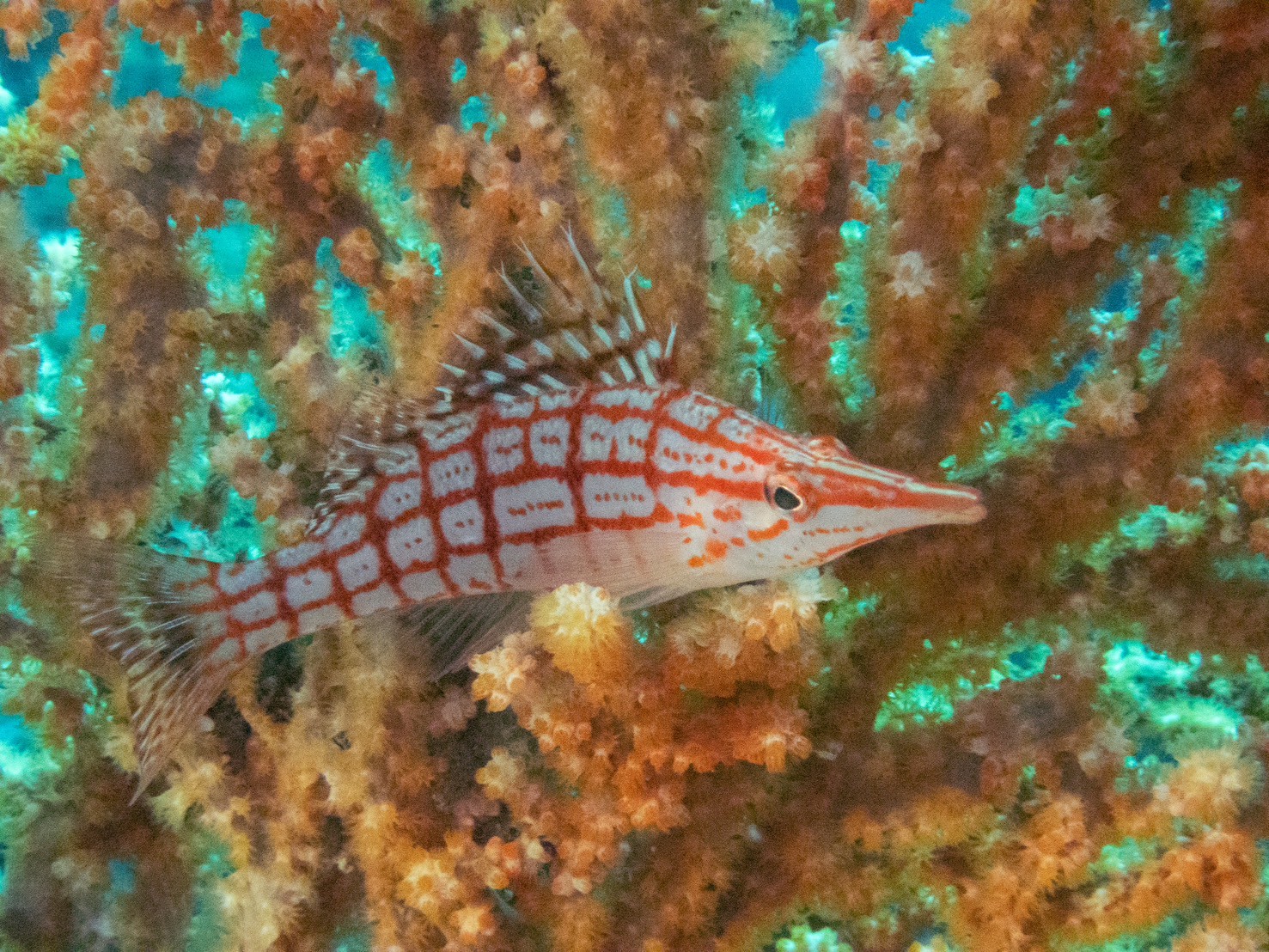
アイキャッチに乗せたクダゴンベ.花(名前何だっけ)の辺りに住み着いてる個体で,かわいらしい模様は見飽きません.
その他にも1mを超えるハタや,黄金伝説で見たアオブダイの小さいやつ(コブダイ)を見ながらのダイビングで,冬からは考えられない生き物密度に感動しました.
70mのドロップの周囲を泳ぎ,ドロップの上から下を眺めた時は少し恐ろしさを覚えました.ファンダイビングでは3,40mが限度なので,道の世界を想像しながら岩肌と深淵を眺めるのは不思議な気持ちです.一方で魚たちにはそんな事は全く関係なく,むしろ彼らの世界であるという事実は彼らに畏敬の念を感じさせます.
そんな伊東のダイビングでした.アイキャッチは友達が撮ったものですが,近日私もカメラ買うのでお楽しみに.
生き物生態
キンギョハナダイ(Pseudanthias squamipinnis)
- サンゴ礁周辺に群れで生息する小型のハナダイの仲間。
- 鮮やかなオレンジ色の体色で、雌はオレンジ、雄は赤みがかっている。
- 雌から雄に性転換する「雌性先熟」の特徴を持つ。
🐟 クダゴンベ(Oxycirrhites typus)
- サンゴやウミカラマツなどの枝の中に住み、体を固定しながら生活する。
- 白地に赤い格子模様が美しく、カメラ派ダイバーに人気。
- 小型の甲殻類などを食べる待ち伏せ型のハンター。
🐟 ハタ類(例:マハタやクエなどのEpinephelus属)
- 沖合や岩礁域に生息する大型肉食魚。夜行性で根魚の代表格。
- 1m以上になる個体も多く、成長が遅いため乱獲に注意が必要。
- 小魚や甲殻類を待ち伏せて捕食する。
🐠 アオブダイ(Scarus coeruleus、日本では他種を指す場合も)
- 鮮やかな青い体色で知られ、サンゴ礁をガリガリとかじる草食性。
- サンゴの表面の藻類を歯で削り取って食べる。
- 糞としてサンゴ砂を排出するなど、サンゴ礁の環境維持に貢献。
🐟 コブダイ(Semicossyphus reticulatus)
日本近海の岩礁域に生息し、貝類や甲殻類などを捕食。
成魚の雄は額に大きなコブができるのが特徴。
雌性先熟で、成長すると雄に性転換する。
Yesterday, July 19, 2025, I went diving in Itō, Izu! Since being discharged from the hospital, diving has become my biggest passion.
Let me briefly explain how I got into it. It all started with a dream I had while I was still hospitalized. In the dream, I was underwater, inside a sea cave. Small fish swam around me, and crabs scuttled along the walls—it was a truly fantastical scene. It felt just like a dream, and at the time, it seemed like something totally out of reach. Even after leaving the hospital, I never even considered trying diving, wondering if my body—still needing to stay hygienic—could handle such an activity. But as I began challenging myself in small ways during daily life, I gradually gained confidence. Eventually, I decided to give it a shot—and that was the start.
Now onto yesterday’s dive! We did a boat dive at a spot called Shirane South. Centered around a huge rock, the area allows diving at depths from about 15 to 30 meters. The highlight was the massive school of Japanese anthias (Pseudanthias squamipinnis, known as “Kingyo-hanadai” in Japanese) swimming in rows along the ocean current. The orange ones are female, and the red ones are males engaging in courtship displays. Setting that aside, they all swam gracefully, constantly entering my field of vision one after another. As I turned this way and that, twisting my body to follow them, I couldn’t take my eyes off their movements. When I drifted toward them, they didn’t flee, nor did they bump into me—just silently passed right in front of me. It was breathtaking.
The Longnose hawkfish (Oxycirrhites typus, “Kudagonbe” in Japanese) I featured as the eye-catcher photo lives near some kind of soft coral (can’t recall the name), and its charming spotted pattern never gets old.
Other highlights included seeing a grouper over 1 meter long, and a juvenile Blue parrotfish (Scarus coeruleus, known locally as “Aobudai”, though this may have actually been a “Kobudai”, Semicossyphus reticulatus, from the show “Golden Legend”). The density of marine life was overwhelming—something unimaginable in the winter.
We swam near a 70-meter drop-off. Peering down from the top of the wall, I felt a touch of fear. Since fun dives are generally limited to 30-40 meters, looking into that unknown abyss while imagining what lies beyond was surreal. On the other hand, the fish paid it no mind at all—as if to remind me that this world is truly theirs. It filled me with awe and respect.
That was my dive in Itō. The photo I used as the eye-catcher was taken by a friend, but I’ll be buying my own camera soon—so stay tuned!
Descriptions
🐠 Japanese Anthias (Pseudanthias squamipinnis)
- These small reef fish live in large schools near coral reefs.
- Females are bright orange, while dominant males turn reddish and lead the group.
- They exhibit protogynous hermaphroditism—females can change into males if the dominant male disappears.
🐟 Longnose Hawkfish (Oxycirrhites typus)
- This species lives perched among soft corals and gorgonians, using its pectoral fins to “sit” on branches.
- It has a white body with red cross-hatching patterns and is popular among underwater photographers.
- It preys on small crustaceans using an ambush strategy.
🐟 Groupers (e.g., Epinephelus spp.)
- Large carnivorous fish that inhabit rocky reefs and coastal areas, often hiding in crevices.
- Some species can grow over 1 meter long but are slow-growing and vulnerable to overfishing.
- They are ambush predators, feeding on smaller fish and crustaceans.
🐠 Blue Parrotfish (Scarus coeruleus / Scarus spp. in general)
- Recognizable by their vibrant blue coloration, they graze on algae growing on coral surfaces.
- Their strong beak-like teeth scrape algae and bits of coral, contributing to sand formation.
- They play a key role in reef ecosystems by controlling algae and recycling coral material.
🐟 Asian Sheepshead Wrasse (Kobudai – Semicossyphus reticulatus)
- Males are known for their prominent forehead bump, which grows as they age.
- They are protogynous hermaphrodites, meaning they start life as females and later become males.
- Found in rocky coastal areas of Japan, they feed on shellfish and crustaceans.
Hier, le 19 juillet 2025, j’ai fait de la plongée à Itō, dans la péninsule d’Izu ! Depuis ma sortie de l’hôpital, c’est devenu ma plus grande passion.
Je vais brièvement vous raconter ce qui m’a motivé à commencer. Tout a commencé par un rêve que j’ai fait pendant mon hospitalisation. Dans ce rêve, j’étais sous l’eau, dans une grotte marine. De petits poissons nageaient autour de moi, des crabes marchaient le long des parois… Un paysage féerique. C’était vraiment comme un rêve, et à l’époque, cela me semblait un monde totalement inaccessible. Même après ma sortie, je n’osais pas évoquer la possibilité de plonger, pensant que, vu mon état de santé et les précautions sanitaires nécessaires, ce serait impossible. Mais petit à petit, en me lançant de petits défis au quotidien, j’ai gagné en confiance. Un jour, j’ai décidé de tenter l’expérience, et tout a commencé là.
Mais revenons à la plongée d’hier ! C’était une plongée en bateau sur le site appelé Shirane Sud. On peut y plonger à une profondeur de 15 à 30 mètres, autour d’un énorme rocher. Ce qui m’a le plus marqué, c’est un banc immense de barbiers japonais (Pseudanthias squamipinnis, appelés “Kingyo-hanadai” en japonais), qui nageaient en ligne suivant le courant. Les femelles sont orange, les mâles rouges, en plein comportement de séduction paraît-il. Mais peu importe, tous nageaient avec élégance, et dans mon champ de vision, de nouveaux poissons apparaissaient sans cesse. Je tournais la tête, pivotais le corps, les observant sans jamais me lasser. En me rapprochant, ils ne fuyaient pas, ne me touchaient pas non plus, mais défilaient tranquillement devant moi. Une scène extraordinaire.
Le poisson-faucon à long nez (Oxycirrhites typus, appelé “Kudagonbe”) que j’ai mis en photo principale vit près d’un certain type de corail (j’ai oublié son nom). Ses motifs mignons sont captivants.
J’ai aussi croisé un mérou de plus d’un mètre, et un jeune poisson-perroquet bleu (Scarus coeruleus, ou peut-être un Kobudai – Semicossyphus reticulatus – vu dans l’émission “Golden Legend”). La densité de vie marine était incroyable, impensable en hiver.
Nous avons nagé près d’un tombant de 70 mètres. En regardant vers le bas depuis le sommet du mur, j’ai ressenti une légère peur. En plongée loisir, on ne dépasse généralement pas les 30 ou 40 mètres, alors imaginer le monde au-delà en contemplant cette paroi rocheuse et les abysses m’a donné un sentiment étrange. Mais les poissons, eux, n’en avaient cure. C’est leur monde, après tout. Et ce simple fait m’a rempli de respect.
Voilà pour cette plongée à Itō. La photo d’illustration a été prise par un ami, mais j’achète bientôt mon propre appareil photo. À suivre !
Descriptions en français
🐠 Barbier japonais (Pseudanthias squamipinnis)
- Ce petit poisson vit en bancs autour des récifs coralliens.
- Les femelles sont orange vif, tandis que les mâles dominants deviennent rougeâtres.
- Ils changent de sexe (hermaphrodisme protogyne) : une femelle peut devenir mâle si le mâle dominant disparaît.
🐟 Poisson-faucon à long nez (Oxycirrhites typus)
- Il vit parmi les coraux mous et les gorgones, s’accrochant avec ses nageoires pectorales.
- Son corps blanc avec des motifs rouges en grille en fait un favori des photographes sous-marins.
- C’est un prédateur embusqué qui se nourrit de petits crustacés.
🐟 Mérous (par exemple, Epinephelus spp.)
- Gros poissons carnivores vivant dans les récifs rocheux et les zones côtières.
- Certaines espèces peuvent dépasser 1 mètre, mais elles grandissent lentement et sont sensibles à la surpêche.
- Ce sont des chasseurs embusqués qui mangent de petits poissons et crustacés.
🐠 Poisson-perroquet bleu (Scarus coeruleus / Scarus spp.)
- Facile à reconnaître par sa couleur bleue éclatante, il broute les algues sur les récifs coralliens.
- Ses dents en forme de bec grattent les algues et contribuent à la formation du sable.
- Il joue un rôle essentiel dans l’équilibre des récifs en contrôlant la prolifération des algues.
🐟 Labre géant asiatique (Kobudai – Semicossyphus reticulatus)
- Le mâle adulte se distingue par une grosse bosse sur le front.
- Espèce hermaphrodite protogyne : tous naissent femelles et certains deviennent mâles en grandissant.
- On le trouve près des côtes rocheuses du Japon, où il mange mollusques et crustacés.

3件のコメント