三回目の九州ダイブは鹿児島市,与次郎が浜の超水道です!桜島を望む海沿いに,空港近くの堤防として設けられたエリアなんだとか.(確か!短期記憶ガバなので間違ってるかも)
三日ほど前から急に気温が下がり,前泊ドミトリーの朝も暑さゼロというか,うっすらヒンヤリ.果たしてウェットで耐えられるか...なんて心配をしながら,ドミトリーから駅に向かい,迎えに来てくださる車を待っていました.
時間通りに到着した迎えの車は,屋久島ツアーのために港まで送迎をした帰りだそうで,インストラクターさんとマンツーマンのダイブ,安心感たっぷりですし,色んな知識を教えてくださいます.
荷物を積み込み,屋久島の事や鹿児島にいる期間の予定の話などしながら,程なくしてダイブポイント近くへ着きました.
荷物を下ろし,一度近くにコンビニまで歩いて,トイレを済ませ,水を買い,再び車に戻り,台車に荷物を乗せてダイブポイントへ向かいました.
イントラさんが指さす方にはクラゲ!!そうです.このスポットはクラゲが名物だそうで,堪能してきました.
二ヵ月空けてからちょっと油断が多いですが,この日もそれが出た...のは要注意重ねますが,楽しいダイブでした!
準備を終え潜ると,すぐにサカサクラゲがたくさん!ホントに逆さです.クラゲと言えば,スカートをブワッとしてフワフワと飛ぶようなイメージですが,彼らは地面に向かってそれをやってます.上はクラゲの足がもぞもぞしてます.足の下にあるスカートを地面に向かってバサバサしてます.パッと見イソギンチャクですが,ちゃんとスカートがあって,クラゲしてます.
光合成をするためだそうで,進化って不思議です.
次に見たのはタコクラゲ.この長水道では9月,10月ぐらいにたくさん見れるそうで,今はシーズン終わりごろです.たくさんいましたが,最盛期はホントに一面にいるんだとか.泳いでるときに,クラゲさんたちの生活を荒らしてしまいそうでちょっと不安なので,未だに初心者が抜けない私にはちょうどいい時期だったかも.
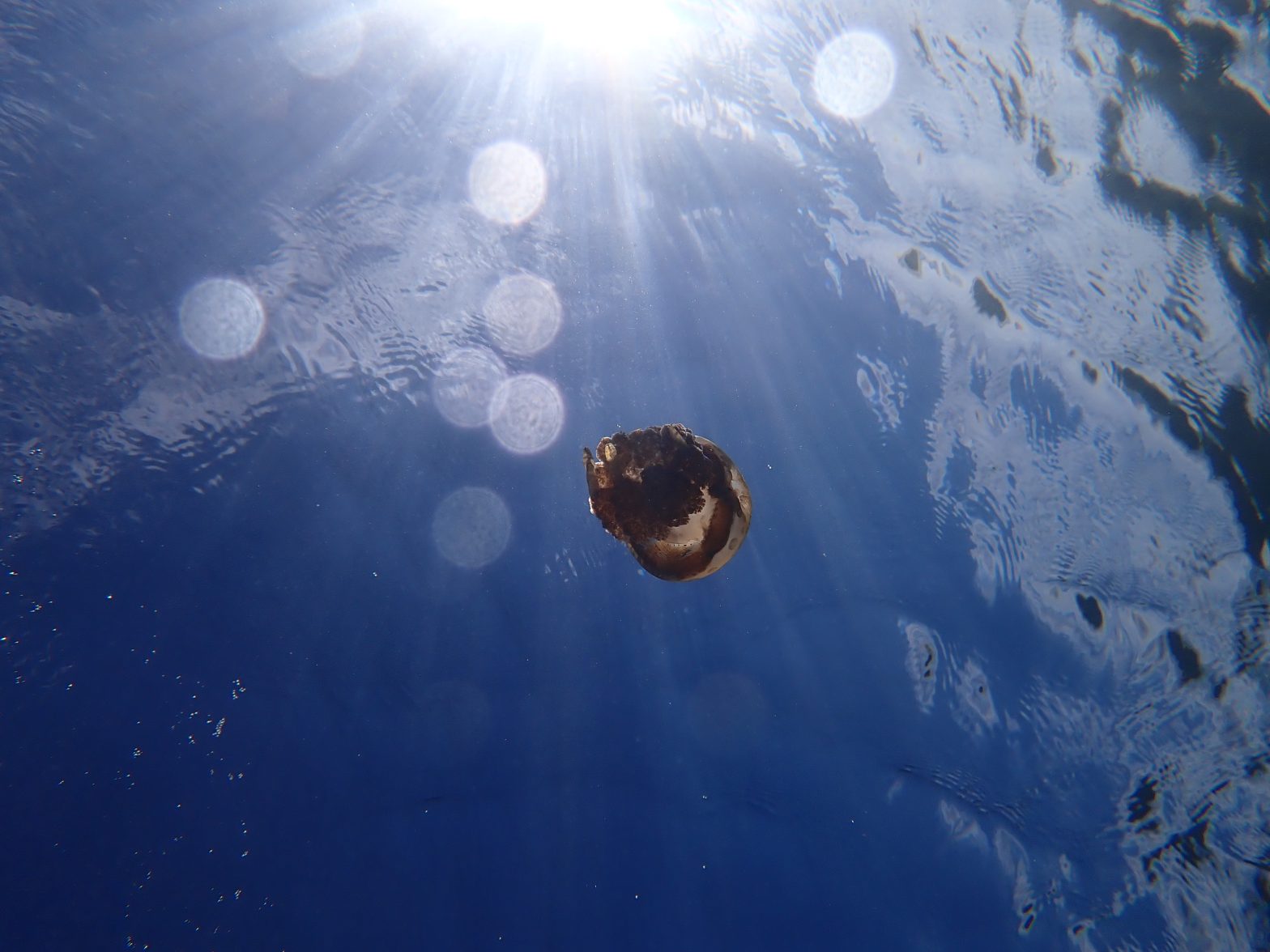
地面に向かうサカサクラゲと違い,普通にフワフワと泳いでます.可愛いです.近くで模様を見るのも良いし,フワフワとこちらに向かってくるのも良いし,教えていただいた,空背景のクラゲがホントにいいです!ホントに空飛んでます!フワライドです!生で見て,写真で撮ってを交互に繰り返し,存分に堪能しました.
今まで分からなかったクラゲの楽しみ方が分かってきました.飛ぶ姿や模様に愛らしさ感じます.それにこの長水道のクラゲは基本的に,長水道の中で生のサイクルを繰り返してるそうで,20m×500m程の領域に全てが詰まってます.
見せていただいた,サカサクラゲのポリプが可愛かったです.糸のようなもので水底に落ちた木に付いていて,糸の先にはクラゲの丸い卵のようなものが付いています.クラゲの元です.中にはポリプから藻掻き,離れてクラゲとして独立しようとしてる子もいます.神秘です.魚やオタマジャクシが卵から出るのも可愛いですが,こちらも可愛いです!
一度見てほしいし,今度は鹿児島水族館かすみだ水族館でその辺に注目して見たいです.
その後はめっちゃ活発に動く貝さんやウンチ途中のナマコなんか見ました.カタツムリが仲間なわけなので,活発に動くやつがいるのは普通はなずなんですが,海中であんなに活発に動いてると良いです!絶えず,動いてましたが,食事を探してたんですかね.その子以外にも数えきれないほどの黒い貝さんがいましたが,活発に動いてた白系の子が印象的でした.
ナマコはウンチ中です.いっぱいいましたが,ちょうどウンチしてたのがその子です.ナマコって,何か...塊って印象なので,ウンチの時の穴が思いのほか大きくて,おぉ生きとるって感じです.
一本目の最後にはタイワンガザミを見ました!ガザミと言えば,ゴツゴツして,ちょっと丸みのある概形に,ちょっと小さいってイメージでしたが,その子はそこらへんで売ってるタラバガニよりデカい!そして,ゴツゴツ具合はもうタラバガニみたい!かっけぇです!その風体でいながら,威嚇とかするでなく控えめにただずんでいます.やっぱりかっけぇです.
水から上がるときに見た,コンクリートの上も綺麗でした.付いた泡が雪原のようで,もう少し温かかったらそこに寝っ転がりたかったです.
一本目はこんな感じでした.上がって改めて気付く寒さ.タンクを交換して,一度トイレに来ますが,やっぱり寒い.九州だからドライスーツは要らんやろなんて思った先月の自分に少し怒りつつ,二本目です.
海に繋がる土管を少し見たい,魚がもう少し見たい,タコクラゲを再び見たい,甲殻類もできれば,という要望を聞いてくださり,まずは魚から.一本目でもいましたが,ハゼやらクロサギやらナガサキスズメダイをじっくり観察です.魚を見る時好きなのが,魚が振り返るときに体を捻らせるところと,正面からこちらを見てるときです.捻りは魚の柔らかさと何だか見返り美人図みたいな雰囲気がいいんですよね.正面はこちらを見てる!!という興奮と薄いな,コヤツら...って画が好きです.魚可愛いです.そして,真っ黒いナガサキスズメダイを何度も撮りながら,観察するのは楽しいです.
ネジリンボウの時は近くまで来てくれたクロサギですが,ここの子たちはちょっと警戒心が高く,なかなかカメラに収まってくれませんでした.俊敏さも良いポイントですが.
その後,再びタコクラゲの良い感じの空映えを狙って撮ってました.長水道は流れが穏やかですが,泥が舞いやすいので,地面には基本的に触らないのが定石ですが,まだまだ触ったしまう事があり,他に人がいたら害児になっていたこと間違いなしですが,水面を向いて仰向けで写真を撮りまくってました.地面がボンベをこする度に泥を巻き上げていたので,注意されましたが,何とか一枚良いのが取れました.申し訳ありあませんでした.
帰りに土管の中も少し照らして見せてもらいました.真っ白なサンゴが生えてますが,時にイセエビがいた事もあるんだとか.ただ,光の入らない土管は怖いですね.たまにテレビとかで取り上げてるような事件を連想させます.
そんなこんなで,ここらで二本目を終えました.というのも,私が寒さで震えてたの気付いて,早めに切り上げてくださいました.私は無理しても,もっと見たいって思ってしまうタイプなので,ありがたいです(笑)
鹿児島で潜れる回数も,半分を切ってるので,残りの期間も楽しんでいきたいです!
それでは!
鹿児島 ダイビング スキューバダイビング ショップ・スクール SB(エスビー)
過去ダイビング記事
九州ダイブ#2.南さつま坊津の海でダイビング!!初めての南さつまは透明度が伊豆の倍近い,素敵な海 – daniel.heart.transplant. 私の心臓移植
九州ダイブ#1九州初ダイビングは錦江湾にて,ネジリンボウのカップルとニシキテッポウエビのトリオを観察です – daniel.heart.transplant. 私の心臓移植
城ヶ島でダイビング1 – daniel.heart.transplant. 私の心臓移植
伊豆・伊東の白根東でのダイビング – daniel.heart.transplant. 私の心臓移植
EN
My third dive in Kyushu took place at Chosuido, Yojirouga-hama in Kagoshima City! It’s an area along the coast with a view of Sakurajima, apparently built as a breakwater near the airport. (At least I think so—my short-term memory isn’t always reliable!)
The temperature suddenly dropped a few days ago, and the dorm I stayed in the night before felt more cool than hot in the morning. I wondered if I’d be able to handle the wetsuit… With that in mind, I headed from the dorm to the station to wait for the car that would pick me up.
The car arrived on time. It had just dropped off guests for a Yakushima tour, so I had a one-on-one dive with the instructor. It felt really reassuring, and I got to learn a lot of interesting things.
After loading the gear and chatting about Yakushima and my plans in Kagoshima, we soon arrived near the dive spot. I carried my stuff, walked to a nearby convenience store to use the restroom and buy water, then returned to the car and loaded the gear onto a cart to head to the dive site.
Pointing in a certain direction, the instructor said, “Jellyfish!” Indeed, this spot is famous for its jellyfish, and I got to enjoy them thoroughly.
After a two-month break, I was a little rusty, and it showed that day… but overall, it was a fun dive! Once we were ready and descended, there were countless upside-down jellyfish right away! Unlike the usual image of jellyfish floating gracefully with their skirts spreading, these guys flap their skirts toward the sea floor while their tentacles move above. At first glance, they look like sea anemones, but they really are jellyfish.
Apparently, they do this to photosynthesize. Evolution is truly fascinating.
Next, we saw the cannonball jellyfish. In this long channel, September and October are the peak season, so this was toward the end. There were many, but during the peak, they apparently cover the whole area. As a beginner who doesn’t want to disturb their lives too much while swimming, this timing was perfect for me.
Unlike the upside-down jellyfish, these float freely. They’re adorable, whether observing their patterns up close or watching them drift toward me. I especially loved the shots against the sky—they really look like they’re flying! Alternating between observing live and taking photos, I enjoyed them to the fullest.
I’m beginning to understand the joy of jellyfish. Their flying forms and patterns are so charming. In this long channel, all life stages repeat within a roughly 20m × 500m area.
The polyp stage of the upside-down jellyfish was so cute. It attaches to wood at the bottom by thread-like structures, with round “eggs” at the tip—essentially baby jellyfish. Some are beginning to separate from the polyp to become independent jellyfish. It’s mysterious. Just like fish or tadpoles hatching, this is surprisingly adorable! I’d like to see this in person someday, maybe at the Kagoshima Aquarium or Kasumida Aquarium.
Later, we saw very active snails and a sea cucumber mid-“business.” Since they’re related to land snails, being active is normal, but seeing them move so energetically underwater was amazing! There were countless black snails, but the active white ones left a strong impression.
The sea cucumber’s hole for excretion was larger than I imagined, which really made it feel alive. At the end of the first dive, we saw a Taiwan gazami crab. Crabs usually seem rough and small, but this one was huge—bigger than commercially sold king crabs—and looked so cool, yet it didn’t act aggressively, just calmly staying put. Truly impressive!
On the way up, I noticed the concrete surface covered with bubbles—it looked like a snowy field. If it were a bit warmer, I would’ve wanted to lie down there. That was the first dive. Coming out of the water, the cold hit me again. After changing tanks and using the restroom, it was still chilly. I slightly regretted thinking I wouldn’t need a dry suit in Kyushu last month.
For the second dive, I wanted to see a sewer pipe connected to the sea, more fish, the cannonball jellyfish again, and maybe some crustaceans. We started with fish. I observed gobies, blackfin chromis, and Nagasaki damselfish carefully. I love seeing the moment a fish twists its body or looks straight at me—it feels like a graceful pose or an exciting stare. Watching the black Nagasaki damselfish repeatedly while taking photos was fun.
The blackfin chromis were more cautious here, so it was harder to capture them. Then I tried to photograph the cannonball jellyfish against the sky again. The channel has gentle currents but easily stirs up mud, so touching the bottom is usually avoided. I accidentally disturbed the mud a bit but managed to get one great shot.
We also briefly explored the sewer pipe. White coral grows there, and sometimes lobsters are present. Dark, lightless spaces are a bit scary—like scenes from TV shows.
The second dive ended early because the instructor noticed I was shivering from the cold. I tend to push myself, so I was grateful for the early cut-off (lol).
I’ve now completed more than half of my dives in Kagoshima and plan to enjoy the rest of my time here fully!
FR
Ma troisième plongée à Kyushu a eu lieu à Chosuido, Yojirouga-hama, à Kagoshima ! C’est une zone le long de la côte avec vue sur Sakurajima, apparemment construite comme digue près de l’aéroport. (Du moins, je crois… ma mémoire à court terme est parfois défaillante !)
Il y a quelques jours, la température a soudainement chuté, et le matin dans le dortoir où j’avais passé la nuit, il faisait plus frais que chaud. Je me demandais si je supporterais la combinaison… Avec cela en tête, je me suis dirigé du dortoir à la gare pour attendre la voiture qui devait venir me chercher.
La voiture est arrivée à l’heure. Elle venait de déposer des clients pour un tour à Yakushima, donc j’avais une plongée individuelle avec l’instructeur. C’était très rassurant, et j’ai appris beaucoup de choses intéressantes.
Après avoir chargé le matériel et discuté de Yakushima et de mon programme à Kagoshima, nous sommes vite arrivés près du site de plongée. J’ai porté mes affaires, marché jusqu’au konbini à proximité pour aller aux toilettes et acheter de l’eau, puis je suis retourné à la voiture pour charger le matériel sur un chariot et nous diriger vers le site de plongée.
L’instructeur pointa du doigt et dit : « Des méduses ! » En effet, ce spot est célèbre pour ses méduses, et j’en ai bien profité.
Après deux mois d’arrêt, j’étais un peu rouillé, et ça s’est vu ce jour-là… mais globalement, c’était une plongée amusante ! Une fois prêts et descendus, nous avons immédiatement vu d’innombrables méduses à l’envers ! Contrairement à l’image habituelle des méduses flottant gracieusement, celles-ci agitent leur jupe vers le fond, tandis que leurs tentacules bougent au-dessus. À première vue, on pourrait croire à des anémones de mer, mais ce sont bien des méduses.
Apparemment, elles font cela pour la photosynthèse. L’évolution est vraiment fascinante.
Ensuite, nous avons vu les méduses-canon. Dans ce long canal, septembre et octobre sont la haute saison, donc c’était la fin. Il y en avait beaucoup, mais à la période de pointe, elles couvrent tout l’espace. Pour une débutante comme moi, qui ne veut pas trop perturber leur vie en nageant, ce moment était parfait.
Contrairement aux méduses à l’envers, celles-ci flottent librement. Elles sont adorables, que ce soit pour observer leurs motifs de près ou les voir venir vers moi. J’ai particulièrement aimé les photos sur fond de ciel – elles semblent vraiment voler ! Alternant observation et photos, j’en ai pleinement profité.
Je commence à comprendre le plaisir des méduses. Leur façon de voler et leurs motifs sont charmants. Dans ce long canal, tous les stades de vie se répètent sur une zone d’environ 20m × 500m.
Le stade polype des méduses à l’envers était trop mignon. Il s’accroche au bois au fond par des filaments, avec de petites “œufs” ronds à l’extrémité — ce sont les futures méduses. Certaines commencent à se séparer pour devenir indépendantes. C’est mystérieux. Comme les poissons ou les têtards qui éclosent, c’est étonnamment mignon ! J’aimerais voir ça en vrai, peut-être au Aquarium de Kagoshima ou à l’Aquarium Kasumida.
Plus tard, nous avons vu des escargots très actifs et un concombre de mer en pleine “action”. Étant apparenté aux escargots terrestres, être actif est normal, mais les voir bouger si énergiquement sous l’eau était impressionnant ! Il y avait d’innombrables escargots noirs, mais les blancs actifs m’ont marqué.
Le trou du concombre de mer pour déféquer était plus grand que je ne l’imaginais, ce qui le rend vraiment vivant. À la fin de la première plongée, nous avons vu un crabe gazami de Taiwan. Les crabes semblent souvent rugueux et petits, mais celui-ci était énorme – plus grand qu’un crabe royal vendu dans le commerce – et tellement impressionnant, sans être agressif, simplement posé tranquillement. Vraiment impressionnant !
En remontant, j’ai remarqué la surface en béton couverte de bulles – on aurait dit un champ de neige. S’il faisait un peu plus chaud, j’aurais voulu m’y allonger. Voilà pour la première plongée. En sortant de l’eau, le froid m’a de nouveau frappé. Après avoir changé de bouteille et utilisé les toilettes, il faisait toujours froid. Je regrettais un peu d’avoir pensé le mois dernier que je n’aurais pas besoin d’une combinaison sèche à Kyushu.
Pour la deuxième plongée, je voulais voir un tuyau reliant la mer, plus de poissons, revoir les méduses-canon et peut-être quelques crustacés. Nous avons commencé par observer les poissons : gobies, chromis noirs et demoiselles de Nagasaki. J’adore le moment où un poisson se retourne ou me regarde droit dans les yeux – c’est comme une pose élégante ou un regard excitant. Observer et photographier les demoiselles de Nagasaki noires était très amusant.
Les chromis étaient plus prudents ici, donc difficile à capturer. Ensuite, j’ai essayé de photographier les méduses-canon sur fond de ciel à nouveau. Le canal a un courant doux mais la boue se soulève facilement, donc toucher le fond est généralement évité. J’ai un peu perturbé la boue, mais j’ai réussi à obtenir un bon cliché.
Nous avons également exploré brièvement le tuyau. Du corail blanc y pousse, et parfois des langoustes s’y trouvent. Les espaces sombres sont un peu effrayants – comme dans certaines émissions télé.
La deuxième plongée s’est terminée tôt car l’instructeur a remarqué que je tremblais de froid. J’ai tendance à vouloir tout voir, donc j’étais reconnaissante pour l’arrêt anticipé (lol).
J’ai maintenant complété plus de la moitié de mes plongées à Kagoshima et je compte bien profiter pleinement du reste de mon temps ici !

1件のコメント