南さつまのダイビングです.前泊して宿に迎えに来ていただき,車に器材を積んで出発.車で約1.5時間で着いた先は穏やかな海でした.引くほど波の無い海...普段は普通程度に波あるみたいですが,滅茶苦茶穏やかでした.車に積んだ器材を下ろし,ウェットスーツとブーツを履いて,残りはトラックへ.移した荷物と共に,漁港として使われている船着場に移動.そこからボートに荷物を移し替え,いざ出発です.
10分程波に揺られ...と言う程の波も無いですが,程無くしてポイントに着いたら,器材をセット,バックドロップという背中から降りる方法で海にダイブです.
直前におにぎりを食べたのがちょっと失敗でしたね...結構満腹感...とは言え普通に潜れましたが.
前回12Lボンベでは1時間は行けそうでしたが,今回は10L.前回から呼吸法を変えたとはいえ,早く終わってしまわないか...という不安で緊張してました.結局50分普通に行けたので良かったです.
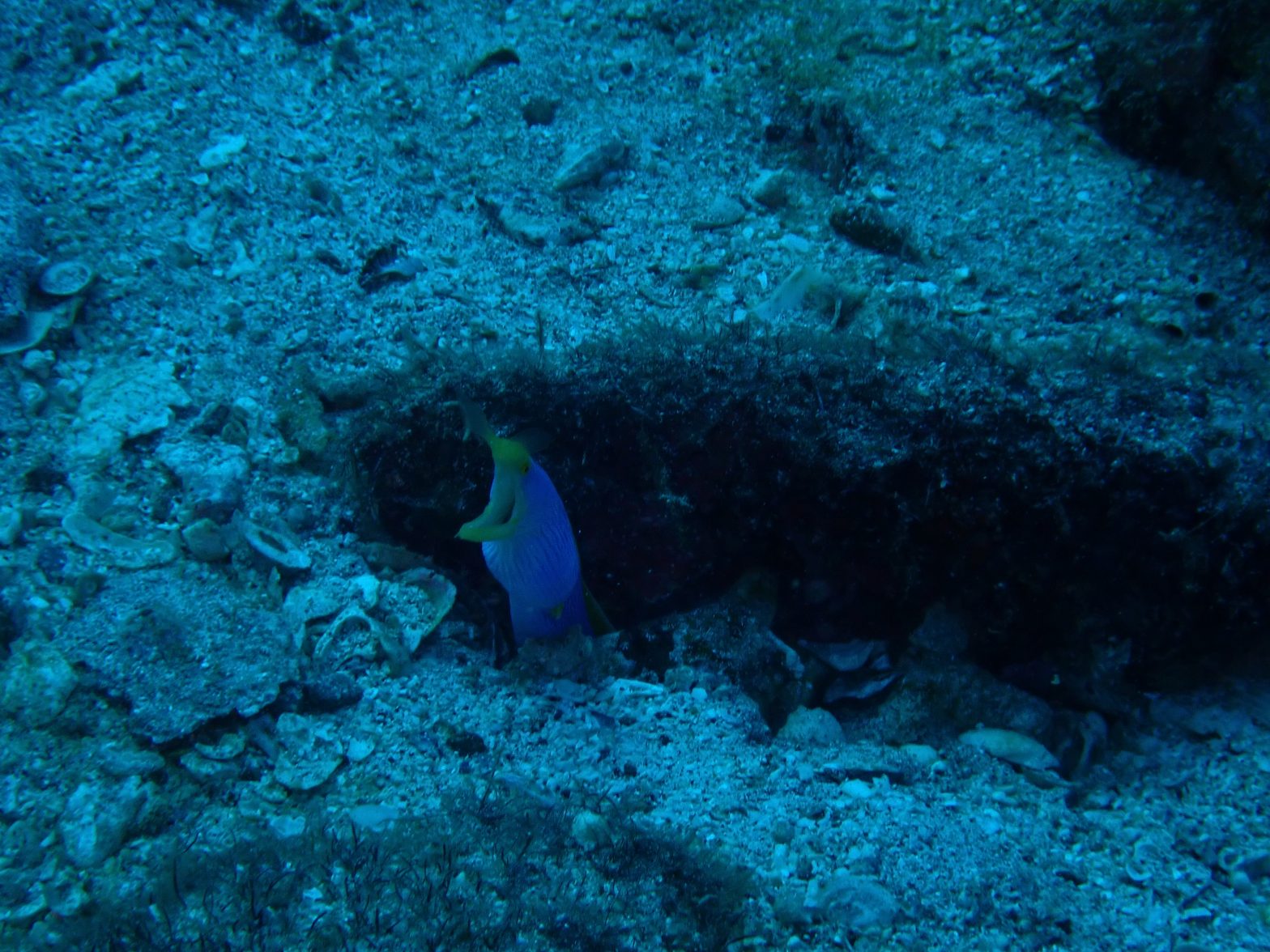
一本目は,アイキャッチにもいる,ハナヒゲウツボとキビナゴか何かの群れをじっくり見ました.よく見るウツボと全く違い,細く,青く,怖いより可愛いが勝ってしまうウツボは,ネジリンボウと同じように穴から顔を出しエサを食べています.人が近づくと顎を大きく開けて威嚇しますが,もう少し近づくと穴に引っ込んでしまいます.威嚇もされない距離から眺めた子です.
魚の群れもそこにいますが,近づくと人を避けます.避けずにぶつかる事もありますが,群れに突っ込みたいという衝動は極力抑えて観察しないといけません.彼らは私達より機敏なので,当たってダメージみたいなヘマはしないと思いますが,驚かせちゃダメです.
この前見た,交尾してるキンギョハナダイは普通にぶつかってきましたね.懐かしい.
表面が穏やかな海は中もとても穏やかです.あれは何だ!これは何だ!ってたくさん言えないがちょっと残念で,伝わりにくいですが,そこを中心にすると,楽しさが薄れちゃうので,ちょっとずつ覚えていきます.
二本目も相変わらず穏やかなダイブでした.クロボシイシモチやマメアジという小さな魚の大群を見ましたが,あとは長閑に海の世界を泳ぎ魚たちを見て回りました.カメラの充電をミスって二本目でカメラ使えなかったですが,黄色い斑点のあるタイみたいなサイズ感の青魚みたいな模様ののんびりしたやつと,全身黒くて尾びれの辺りが青っぽかった30dmぐらいのやつが個人的に気になってます.彼らはなんていうんだろう...次回のお楽しみかな.
話によると,カツオも出ればマグロも出る,小魚も出ればジンベイザメやクジラも出たりする,何でもいる海らしいです.鹿児島いる間にじっくり楽しみたいです.
それから,ガイドさんが1,2本目間の休憩時間に釣りしてて,竿借りてやらせてもらいましたが,私には釣りの楽しさは分からないかもでした...釣っても,生魚は食べれらませんしね.
海で見る方がいい.
そんな感想を残し今日はこの辺で.
https://aquatrip-diving.synapse.kagoshima.jp/
過去ダイビング記事
九州ダイブ#1九州初ダイビングは錦江湾にて,ネジリンボウのカップルとニシキテッポウエビのトリオを観察です – daniel.heart.transplant. 私の心臓移植
城ヶ島でダイビング1 – daniel.heart.transplant. 私の心臓移植
伊豆・伊東の白根東でのダイビング – daniel.heart.transplant. 私の心臓移植
This was a diving day in Minamisatsuma.
I stayed overnight nearby, and in the morning the staff came to pick me up.
We loaded the diving gear into the car and set off. About an hour and a half later, we arrived at the sea — calm beyond belief. I heard it’s usually a bit wavier, but that day it was almost eerily still.
We unloaded the equipment, put on wetsuits and boots, and sent the rest to the truck. Then we moved to the pier, which also serves as a fishing port, transferred the gear onto the boat, and set out.
After about ten minutes of gentle rocking — though “rocking” might be too strong a word — we arrived at the diving point.
Once we’d set up our equipment, it was time for the backdrop entry, diving into the sea backward off the boat.
I’d made the mistake of eating an onigiri just before — feeling quite full, to be honest.
Still, I managed the dive fine. Last time, with a 12L tank, I could go for about an hour; this time I had a 10L.
Even though I’d improved my breathing technique, I was nervous I’d use it up too fast… but I lasted 50 minutes just fine.
On the first dive, I saw a ribbon eel — the same one on the cover photo — and a shimmering school of small fish, maybe sardines or anchovies.
Unlike the thick, intimidating eels you often see, ribbon eels are slim, bright blue, and surprisingly cute.
They poke their heads out from holes like gobies do, snatching food that passes by.
If you get too close, they open their jaws wide to threaten you — get even closer, and they vanish into their burrows.
I watched one quietly from a safe distance, not disturbing it.
The schools of fish nearby would dart away if I approached.
Sometimes they even bumped into me, but as tempting as it is to swim straight into the swarm, it’s better to resist that impulse — after all, the goal is to observe, not to startle them.
(Though, I still remember those goldfish anthias mating last time — they had no hesitation bumping right into me.)
The sea was calm on the surface, and just as peaceful below.
I couldn’t keep saying “What’s that?” over and over like last time, which is a bit of a shame — but if I only focus on naming things, I lose the joy of simply being there.
So I’ll learn little by little.
The second dive was just as tranquil.
We saw huge schools of small fish like cardinalfish and baby jack mackerel.
I missed capturing them because my camera battery ran out, but two fish really caught my eye:
one about the size of a sea bream, with a yellow-dotted blue body that swam lazily by,
and another, about 30 cm long, all black with a hint of blue at the tail.
I wonder what they were — maybe I’ll find out next time.
Apparently, in these waters you can encounter everything — from bonito to tuna, from tiny fish to whale sharks and even whales.
It’s said to be a sea where “anything can appear.”
I’d love to explore it more deeply while I’m in Kagoshima.
During the break between the first and second dives, my guide did a bit of fishing and let me try.
Honestly… I don’t think fishing is for me.
Even if I caught one, I couldn’t eat it raw anyway.
I’d rather watch them underwater.
And with that thought, I’ll wrap it up for today.
C’était une journée de plongée à Minamisatsuma, au sud de Kagoshima.
J’avais passé la nuit dans une auberge, et le matin, on est venu me chercher.
Nous avons chargé tout le matériel dans la voiture et pris la route. Après environ une heure et demie, nous sommes arrivés devant une mer incroyablement calme — presque sans aucune vague.
On m’a dit qu’il y en avait d’habitude un peu, mais ce jour-là, c’était d’un calme absolu.
Nous avons déchargé le matériel, mis nos combinaisons et nos bottillons, puis tout le reste est parti dans un petit camion. Ensuite, nous avons rejoint le port de pêche pour embarquer sur un bateau, direction le large.
Après une dizaine de minutes de navigation — si on peut appeler ça des vagues — nous sommes arrivés sur le site de plongée.
Le matériel prêt, j’ai plongé en arrière, selon la méthode du backdrop.
J’avais eu la mauvaise idée de manger un onigiri juste avant… J’étais un peu trop rassasié.
Mais bon, la plongée s’est bien passée.
La dernière fois, avec une bouteille de 12 L, j’avais pu rester environ une heure ; cette fois, c’était une 10 L.
Même si j’avais amélioré ma respiration, j’avais peur de manquer d’air trop vite… Finalement, j’ai tenu cinquante minutes, sans problème.
Lors de la première plongée, j’ai observé un anguille-ruban bleue (celle de la photo de couverture) ainsi qu’un banc étincelant de petits poissons — peut-être des sardines.
Rien à voir avec les murènes massives et menaçantes qu’on voit d’habitude : celle-ci était fine, bleue, presque mignonne.
Comme les gobies, elle sortait la tête de son trou pour attraper sa nourriture.
Si on s’approche trop, elle ouvre grand la gueule pour menacer ; un peu plus près, et elle disparaît aussitôt.
Je l’ai observée à distance, sans la déranger.
Les bancs de poissons nageaient tout près, mais s’écartaient dès qu’on approchait.
Il arrive parfois qu’ils nous frôlent, mais il faut résister à la tentation de plonger au milieu d’eux — le but, c’est d’observer, pas d’effrayer.
Je me suis rappelé un couple de poissons-soldats aperçus la dernière fois, en pleine parade nuptiale, qui eux n’avaient pas peur de foncer dans tout !
La mer, calme en surface, l’était tout autant en profondeur.
C’est un peu dommage de ne pas pouvoir s’exclamer sans arrêt « C’est quoi ça ? », mais si je ne fais que chercher des noms, j’en oublie la beauté du moment.
Alors, j’apprends doucement.
La deuxième plongée fut tout aussi paisible.
Nous avons vu d’immenses bancs de petits poissons, comme des apogons ou des jeunes chinchards.
Ma caméra n’avait plus de batterie, hélas, mais deux poissons ont particulièrement retenu mon attention :
l’un, bleu tacheté de jaune, à peu près de la taille d’une dorade, nageait lentement ;
l’autre, entièrement noir, avec le bout de la queue bleuâtre, mesurait une trentaine de centimètres.
Je me demande bien quelles espèces c’étaient — à découvrir la prochaine fois, sans doute.
D’après le guide, ici on peut tout croiser : des bonites, des thons, des petits poissons, voire des requins-baleines ou même des baleines.
Une mer où tout peut apparaître, dit-on.
J’aimerais en profiter autant que possible pendant mon séjour à Kagoshima.
Entre les deux plongées, mon guide a sorti sa canne à pêche et m’a proposé d’essayer.
Mais… je crois que la pêche, ce n’est pas pour moi.
Même si j’en attrapais un, je ne pourrais pas le manger cru de toute façon.
Je préfère les admirer sous l’eau.
Et sur cette pensée, je termine ma journée.

1件のコメント